Why Gas Engine Oil Gets Changed Early: Silicon, Wear Metals and Drain Intervals

Three reasons gas engine oil comes out
Every gas engine oil change comes down to one of three things:
- The oil itself is worn out. Its base number (TBN) has run down neutralising combustion acids, its acid number (TAN) is climbing, and oxidation and nitration have aged it. This is real end of life, and no filter reverses it.
- The oil is contaminated. Silicon from siloxanes, chlorine from landfill gas, water or coolant. The oil may still be chemically healthy, but what it’s carrying is dangerous.
- The engine is wearing. Iron, chrome, aluminium, copper and lead rising in the oil show metal leaving liners, rings, pistons and bearings.
Only the first means the oil has genuinely reached the end of its life. On landfill and biogas engines, it’s usually the second that triggers the change.
Silicon: the number that sets the drain interval
Landfill gas carries siloxanes, silicon compounds from cosmetics, detergents and other consumer products that break down in the waste. In the combustion chamber they burn to silica: essentially glass, and very hard.
That silica coats valves, piston crowns, spark plugs and turbochargers, and finds its way into the oil. Lubricant makers link it to higher oil consumption, pre-ignition, abrasive wear and more frequent top-end overhauls. The exhaust valve usually takes the worst of it.
So every gas engine OEM sets a silicon limit for the oil. Depending on the engine maker, the application and the gas, that limit typically sits somewhere between 100 and 300 ppm. When the oil reaches it, the oil comes out, whatever the rest of the report says.
What the silicon number doesn’t tell you
Here is the problem with letting one number run the site.
Silicon in used oil is normally measured by ICP elemental analysis (ASTM D5185). It reports the total silicon present, but it only picks up material in particles below roughly 10 microns, and it can’t tell you what form that silicon is in.
That matters, because silicon in oil isn’t all the same thing. Some of it is hard, abrasive silica particles doing real damage. Some is in forms far less harmful to the engine. A ppm figure adds them all together.
We saw this directly in a trial on three UK landfill gas engines fitted with Delta-Xero DX1006-T filtration units, with samples tested by POLARIS Laboratories. Two samples gave almost the same silicon reading: 261 ppm and 240 ppm. A micropatch test, a visual check of what is actually suspended in the oil, told a different story. After filtration, there was far less visible abrasive debris. The filters had taken out most of the particles that cause wear. Base number and acid number stayed well inside the OEM’s limits.
The ppm figure alone would have changed both oils.
Wear metals: the engine’s side of the story
Wear metals are how you find out whether the silicon is actually hurting the engine.
Read silicon and iron together. Silicon rising with iron flat suggests contamination that isn’t yet causing measurable wear. Silicon and iron rising together means abrasive wear in progress, usually on liners and rings. Rising chrome points at ring wear; copper and lead at bearings.
The trend matters more than any single result. One high reading is a question. Three rising readings in a row are an answer. If you want a refresher on what each line of a report means, see our guide to reading an oil analysis report.
For the limits that apply to your engine, use the OEM’s figures, not general rules of thumb. Jenbacher, Caterpillar, MWM and others publish their own.
Three ways to set a drain interval
| Approach | How it works | What it costs you |
|---|---|---|
| Fixed hours | Oil changed every X hours regardless of condition | Simple, but changes good oil and can miss bad oil |
| Silicon-gated | Oil changed when silicon hits the OEM limit | Protects against abrasion, but on landfill gas can mean weekly changes while the oil is otherwise healthy |
| Condition-based | Oil changed when the full picture says so: TBN, TAN, oxidation, nitration, silicon, wear metals and micropatch, trended over time | Needs regular sampling, but changes oil only when it’s needed |
The first two are easy to run. The third is the one that cuts oil spend.
What changed on real landfill engines
Three UK landfill gas engines. With DX1006-T units fitted and micropatch testing added to routine analysis, the operator moved from a weekly oil change at around 150 hours to an average of about 650 hours. That means far fewer changes per engine, less labour, and less waste oil to dispose of.
Landfill gas engine at a renewable energy plant. On an engine taking about 500 litres a change, oil changes fell from around 48 a year to 7 during long-term testing verified by independent lab analysis. That’s roughly 20,500 litres less new oil and 20,500 litres less waste oil per engine per year. Read the case study.
CAT and Jenbacher engines across several sites. Field testing cut silicon and related abrasive contamination by 63%, oil drains by 67.4% and annual costs by 46%. Read the case study.
More results from gas engine sites are in our gas engine case studies.
What to do on your site
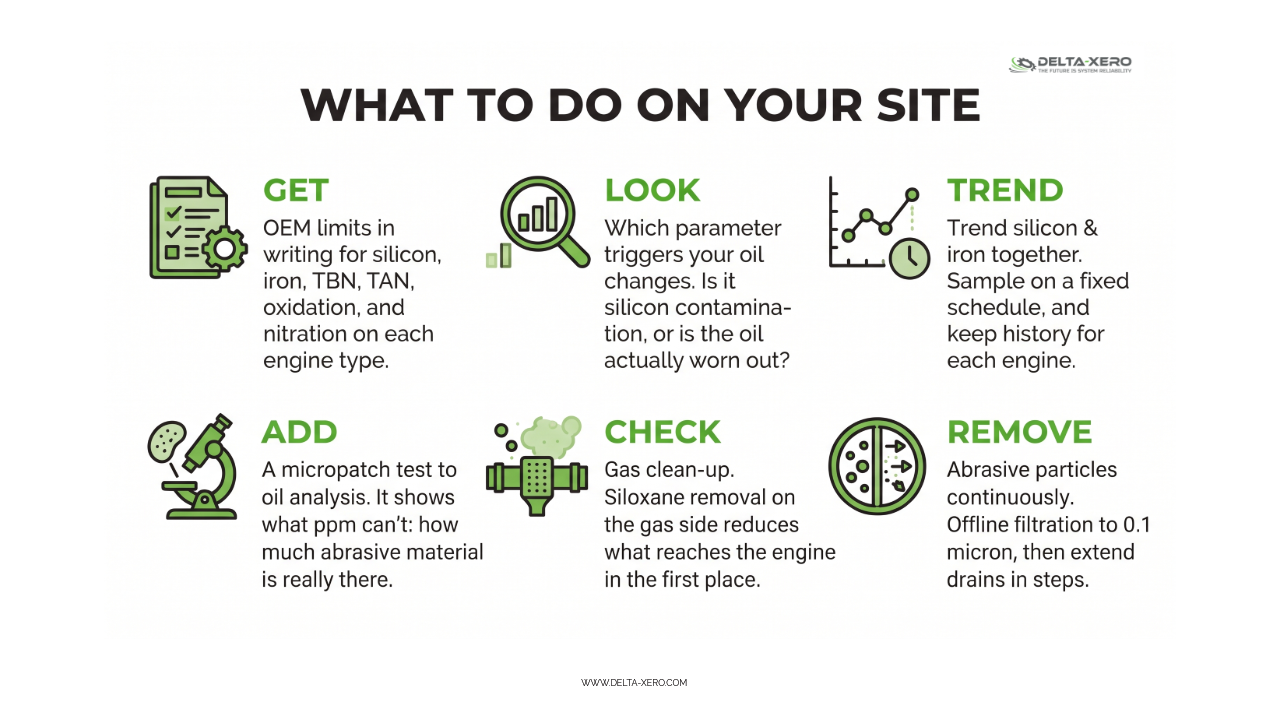
- Get the OEM limits in writing for silicon, iron, TBN, TAN, oxidation and nitration on each engine type you run.
- Look at which parameter actually triggers your oil changes. If it’s silicon every time while the oil chemistry is fine, you’re changing oil for contamination, not wear-out.
- Trend silicon and iron together, sample on a fixed schedule, and keep the history per engine.
- Add a micropatch test to your oil analysis package. It shows what the ppm number can’t: how much abrasive material is really in the oil.
- Check your gas clean-up. Siloxane removal on the gas side reduces what reaches the engine in the first place. Oil filtration deals with what gets through.
- Remove abrasive particles from the oil continuously. Offline filtration down to 0.1 micron takes out the fine silica the engine’s own filters pass. Then extend the drain in steps, sampling as you go.
Want to know what’s really driving your oil changes? We’ll analyse a sample from one of your engines for free, including a micropatch, and tell you whether it’s the oil, the contamination or the engine. Request a free oil analysis, or see how we work with landfill and biogas sites.
Gas engine oil: the questions we get asked
01How often should gas engine oil be changed?
02What is the silicon limit for gas engine oil?
03Where does silicon in landfill gas engine oil come from?
04Can filtration reduce silicon in gas engine oil?
05Which oil analysis tests matter most for landfill gas engines?


Our thoughts on other industries
Real-world fluid conditioning results from sectors adjacent to yours — see how offline nano-filtration performs across our other industry case studies.


