Your Oil Passed ISO 4406. So Why Is the Gearbox Still Failing?

What the three numbers in an ISO 4406 code actually count
ISO 4406 is a reporting code, not a specification. The current edition, ISO 4406:2021, is the fourth, published in January 2021 and replacing the 2017 revision. It converts particle counts into three range numbers: particles at or above 4 micron(c) per millilitre, particles at or above 6 micron(c), and particles at or above 14 micron(c).
Two things follow from that, and both matter.
It counts nothing below 4 microns. The scale simply starts there. A fluid saturated with 2 micron wear debris and a fluid with none of it return the same code.
It counts solid particles only. Water, varnish, oxidation by-products, acids, siloxane and salts do not appear anywhere in those three numbers.
The standard is also explicit that it does not tell you what is acceptable. It defines how to express contamination. The equipment manufacturer defines the target. Which brings us to the part most people have never actually looked at.
There is a dash where your 4 micron limit should be
The in-service cleanliness requirement in IEC 61400-4, the design standard for wind turbine gearboxes, for bulk oil sampled on the maintenance schedule is: –/16/13.
Read that first channel again. It is a dash.
The wind industry's own gearbox standard sets a limit at 6 microns and at 14 microns, and no limit at all at 4 microns. Oil can be fully compliant with IEC 61400-4 while carrying an effectively unbounded population of 4 to 6 micron particles. And since the code cannot see below 4 microns either, an unbounded population beneath that too.
It is worth checking which edition your operations and maintenance contract references. IEC 61400-4 moved to Edition 2.0 in April 2025, and a dedicated technical report on drivetrain lubrication, IEC/TR 61400-4-2, followed in 2026. A specification written against the 2012 edition is now two revisions behind.
Why 4 microns is not a safe floor
The reason small particles matter is film thickness.
In a loaded gear or bearing contact, the elastohydrodynamic oil film separating the two surfaces is extremely thin. Particles larger than that film get entrained between gear teeth and between rollers and raceways. Each one creates a stress concentration, a dent. Dents become micropits. Micropits grow into macropits. That is the failure mode, and it is driven by particles far smaller than the ones the third number in your code is counting.
A healthy, well filtered wind gearbox typically runs around ISO 12/9/5. Compare that to the –/16/13 minimum and the gap between compliant and actually clean is several orders of magnitude of particle count.
Meanwhile, standard practice puts inline filters at 50 micron and 10 micron, with offline filtration reaching 3 to 5 micron. Conventional best practice stops filtering at roughly the same point the measurement stops counting. Everything below that is neither removed nor recorded, and it is precisely the size range that sits closest to the film.
Delta-Xero systems filter to 0.1 micron, well below the smallest bracket ISO 4406 recognises. That is not a bigger number for its own sake. It is the range where the code goes blind.
Three contaminants the code cannot see at all
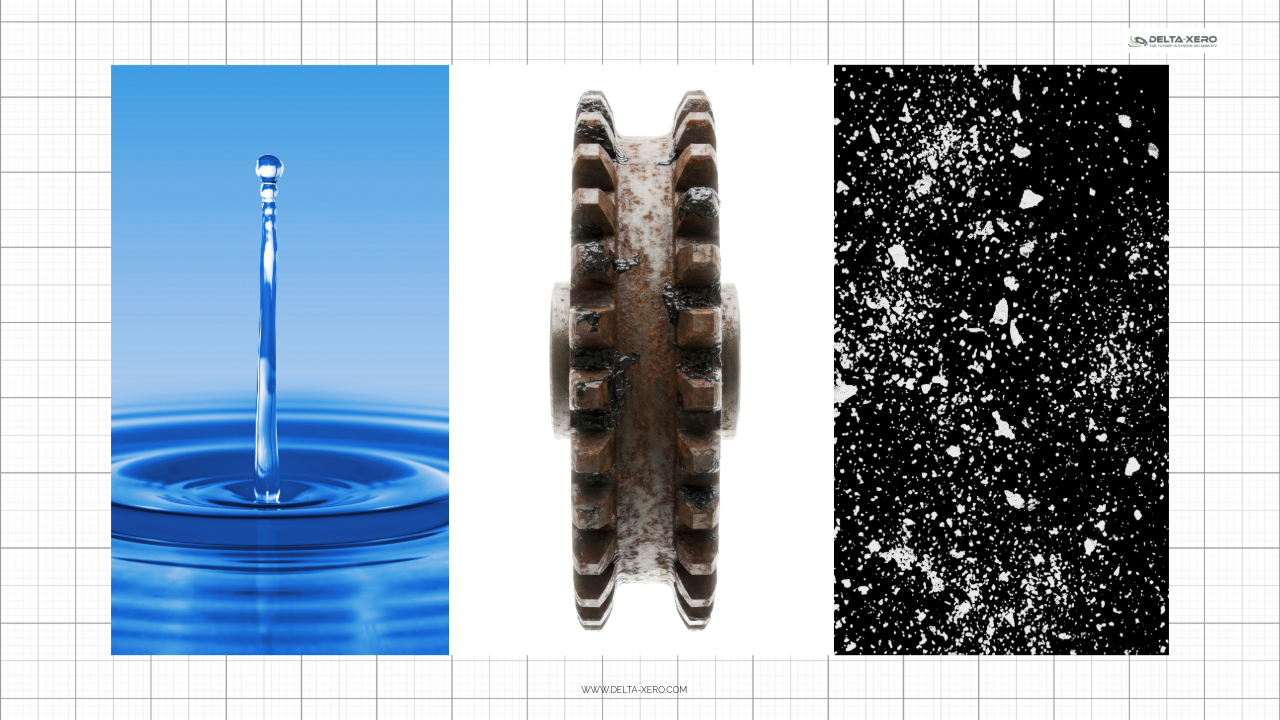
Water. Measured by Karl Fischer titration (ASTM D6304), not by particle count. Worse, an optical particle counter will happily count free water droplets and entrained air as solid particles, so water can inflate your ISO code and send you looking for a particulate problem that is not there.
Varnish and oxidation products. These are soluble at operating temperature and drop out of solution as the oil cools, which is why deposits appear on cool surfaces during a shutdown while every particle count taken at temperature looked clean. Varnish is measured by MPC (ASTM D7843) and has no relationship to ISO 4406 whatsoever — we covered how to read those results in MPC Varnish Test Explained.
Sub-micron wear debris and salts. Below the floor. Invisible.
If you want the fuller picture of what a report does and doesn't tell you, we covered the anatomy of an oil analysis in Hydraulic Oil Analysis: How to Read Your Report.
What this looks like on an actual gearbox
A Bonus 300 kW wind turbine with more than ten years of service. Persistent oil discolouration and internal contamination, after repeated oil changes and flushing. Fresh lubricant degraded rapidly every time.
That last detail is the tell. When new oil goes off quickly, the problem is not the oil. It is what the oil is being poured onto: legacy varnish and retained contamination bonded to internal surfaces, which a drain and fill does not touch and a particle count does not see.
What identified it was micropatch analysis, a physical patch of what was actually in the fluid, not a cleanliness code. Offline filtration restored the oil condition in 51 days, confirmed by before and after micropatch imaging. The full documentation, including the before and after imaging, is in the wind turbine gearbox case study.
In a separate wind turbine gearbox case, 10 year old condemned gearbox oil was filtered for 22 hours. Particle reductions were reported at 94.5 percent for 4 micron and 6 micron particles and 97.6 percent for 14 micron particles after partial filtration, and the oil was confirmed fit for reuse by independent laboratory reports and by the oil producer's own laboratory.
Note where the biggest problem sat. The 4 and 6 micron populations, the ones IEC 61400-4 either bounds loosely or does not bound at all, were the ones carrying the contamination.
Watch the system running on a wind turbine gearbox
What to do differently on Monday
- Check which edition of IEC 61400-4 your maintenance specification cites. If it is the 2012 edition, it predates two revisions.
- Stop accepting a bare ISO code as a clean bill of health. Pair it with MPC varnish testing (ASTM D7843), Karl Fischer water content (ASTM D6304) and a micropatch. Three inexpensive tests that see what the code cannot. If you are not sure how to read what comes back, start with Hydraulic Oil Analysis Explained.
- Trend, do not spot check. A single in-target code tells you almost nothing. The direction of travel tells you everything.
- Treat rapid post-change degradation as a surface problem, not a fluid problem. If fresh oil darkens within weeks, flushing harder will not fix it.
- Filter below the floor of the measurement. If the code stops at 4 microns and best practice offline filtration stops at 3, sub-micron contamination is being managed by nobody.
ISO 4406 is a good standard. It is precise, repeatable and useful for the narrow thing it does: expressing how many solid particles above three thresholds are suspended in a sample. It was never a warranty on gearbox health. Treating it as one is how a compliant oil report and a failing gearbox end up sitting on the same desk.

Delta-Xero offline fluid conditioning removes particulate, water, varnish and oxidation products down to 0.1 micron below the smallest size ISO 4406 measures. The DX1525 Series is built for reservoirs up to 1,200 litres and a nacelle-sized footprint. See the full range of offline filtration systems, or send us an oil sample and we will tell you what is actually in it.
ISO 4406 and gearbox oil: the questions we get asked
01What do the three numbers in an ISO 4406 code actually mean?
02Does ISO 4406 measure water or varnish in oil?
03What oil cleanliness target should a wind turbine gearbox meet?
04Why does gearbox oil darken again soon after an oil change?


Our thoughts on other industries
Real-world fluid conditioning results from sectors adjacent to yours — see how offline nano-filtration performs across our other industry case studies.


