Why Winter Is When Water Gets Into Your Oil and What It Costs You

How water gets in when it’s cold
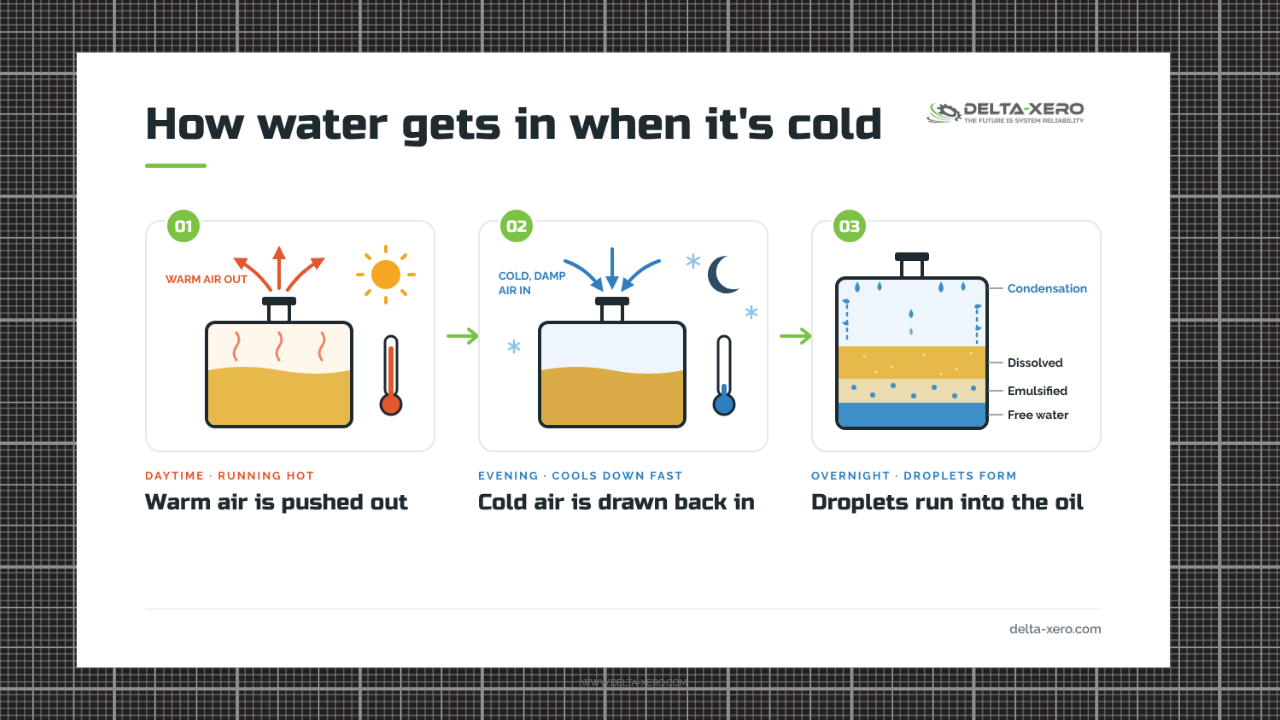
Your equipment breathes
Any reservoir or gearbox with a breather is exchanging air with the outside world. As the oil warms up during the day, air is pushed out. As it cools overnight or during a shutdown, the system pulls fresh air back in.
In winter that air is often cold, damp and close to saturation. When it meets cold metal surfaces inside the tank or gearbox housing, the moisture condenses into droplets on the walls and roof of the headspace – and runs down into the oil. One cycle adds very little. Weeks of daily heating and cooling add up.
Oil holds less water as it cools
Oil can hold a certain amount of water in dissolved form, invisible to the eye. That limit drops as the oil cools. So oil that looked perfectly bright and clear while it was running warm can turn hazy once the machine stops and the temperature falls – the same water is still there, it has just come out of solution.
This is why intermittent equipment suffers most in winter: standby generators, cranes, mobile plant, wind turbine gearboxes during low-wind spells, and any machine that sits idle overnight or over the weekend.
The three states of water in oil
- Dissolved water – spread through the oil at a molecular level. You can’t see it, but it is still there.
- Emulsified water – tiny droplets in suspension in the oil, which can make it look cloudy or milky.
- Free water – water that has separated out and settled at the bottom of a tank or sump.
Cold weather pushes water from the first state towards the second and third – which is exactly where it starts doing harm.
What water does to your oil and your equipment

Water rarely causes a sudden, dramatic failure. It works slowly, which is what makes it expensive.
- Rust and corrosion – on bearings, gear teeth, valve spools and the inside of tanks. Rust particles then become abrasive contamination in their own right.
- Weaker lubricating film – water is a poor lubricant. Where it reaches a loaded contact, such as a rolling bearing or gear mesh, the protective oil film is weakened and wear accelerates.
- Faster oil ageing – water speeds up oxidation and can break down some additives, shortening the useful life of the oil.
- Sludge and blocked filters – water reacts with additives and degradation products to form sludge, which loads up in-line filters and restricts flow.
- Microbial growth in fuel – in diesel storage, free water at the bottom of a tank is where diesel bug lives.
The end result is the same set of costs maintenance teams already know: oil changed earlier than it should be, more filter changes, components replaced before their time, and unplanned downtime.
Signs you already have a winter water problem
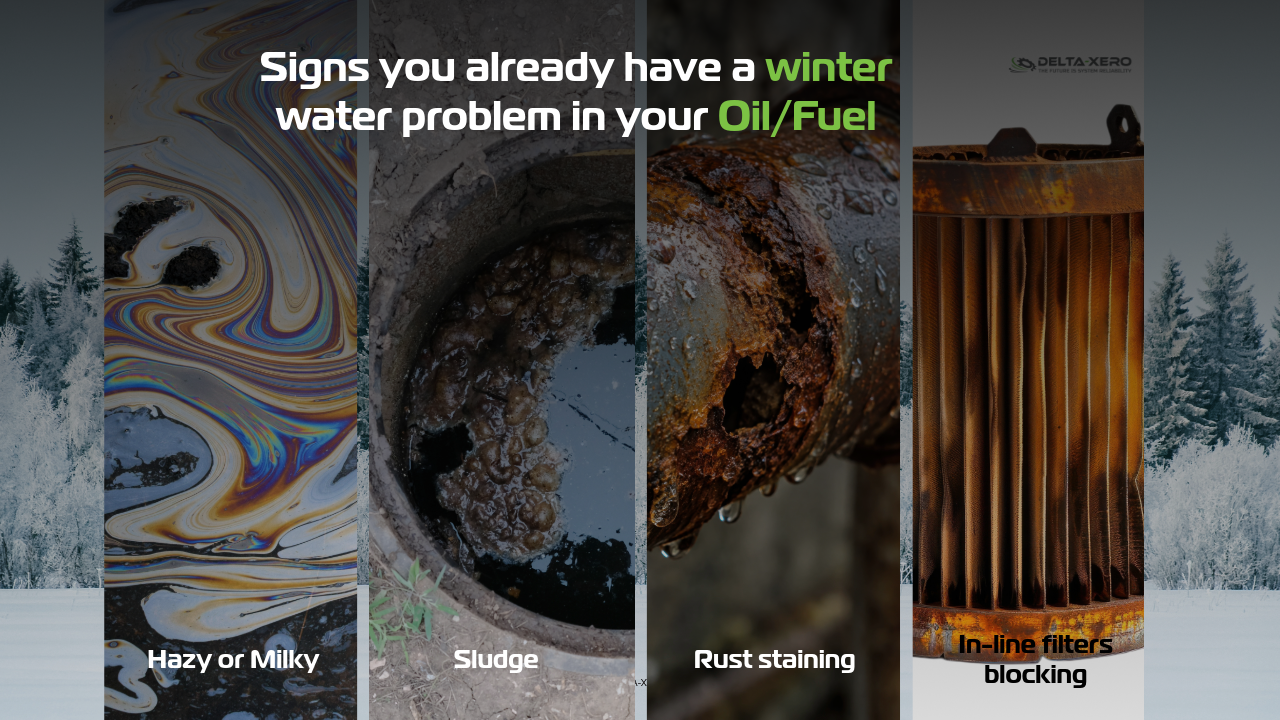
- Oil looks hazy or milky, especially in a sample taken from a cold machine
- Water or sludge appears when you drain the bottom of a tank or sump
- Rust staining on dipsticks, sight glasses or inside inspection covers
- In-line filters blocking faster than usual
- Oil analysis showing rising water content alongside rising particle counts or oxidation
If you’re seeing any of these, it’s worth taking a sample now rather than waiting for the spring service.
What you can do about it
1. Sample and measure first
You can’t manage what you haven’t measured. A water content test (alongside a particle count against ISO 4406) tells you how much water is present and gives you a baseline to compare against after you act. Take samples from a running, representative point – not the bottom drain – so the result reflects the oil the machine actually sees. If you need a refresher on the numbers, see our guide to reading an oil analysis report.
2. Stop the water getting in
- Fit desiccant or sealed breathers on reservoirs and gearboxes where open breathers are used
- Check seals, hatches and cap gaskets – especially on outdoor equipment
- Keep stored oil and fuel indoors or covered, and keep drums sealed
- Where practical, keep bulk storage tanks full to reduce the headspace available for condensation
3. Take out the water that’s already there
Prevention slows the problem down. It doesn’t remove water that is already in the system. That needs continuous conditioning.
An offline (kidney loop) filtration system runs independently of the machine, drawing oil from the reservoir, cleaning it and returning it – continuously, whether the machine is running or not. Because it works around the clock, it keeps on top of the water that each cold night adds, rather than dealing with it once a year at an oil change.
Delta-Xero systems remove water, particles down to 0.1 micron, and oxidation products in one pass through our capillary cartridges. The DX1525 suits compact systems up to 1,200 litres of ISO VG 32 hydraulic oil, such as individual machines and wind turbine nacelles; the DX1000 scales from one to twelve cartridges for larger and harsher installations.
4. Check the result
Re-sample after a few weeks of conditioning. Falling water content and a lower ISO 4406 code are the evidence that it’s working – and the numbers you need to justify extending oil change intervals.
The bottom line
Winter doesn’t add a lot of water in one go. It adds a little, every night, to every system that breathes. Left alone, that water shortens oil life, wears out components and drives up maintenance costs. Measured and managed, it’s one of the easiest contamination problems to fix.
Want to know how much water is in your oil right now? Talk to our team about sampling your systems – we’ll test, measure and recommend the right configuration for your fluid, equipment and operating conditions. Request a free oil analysis or contact Delta-Xero.
Water in oil: the questions we get asked
01Why does my hydraulic oil look cloudy in winter?
02How does water get into a sealed gearbox or hydraulic tank?
03Can water be removed from oil without changing it?
04How often should I test oil for water in winter?


Our thoughts on other industries
Real-world fluid conditioning results from sectors adjacent to yours — see how offline nano-filtration performs across our other industry case studies.


